
Anti-cheat
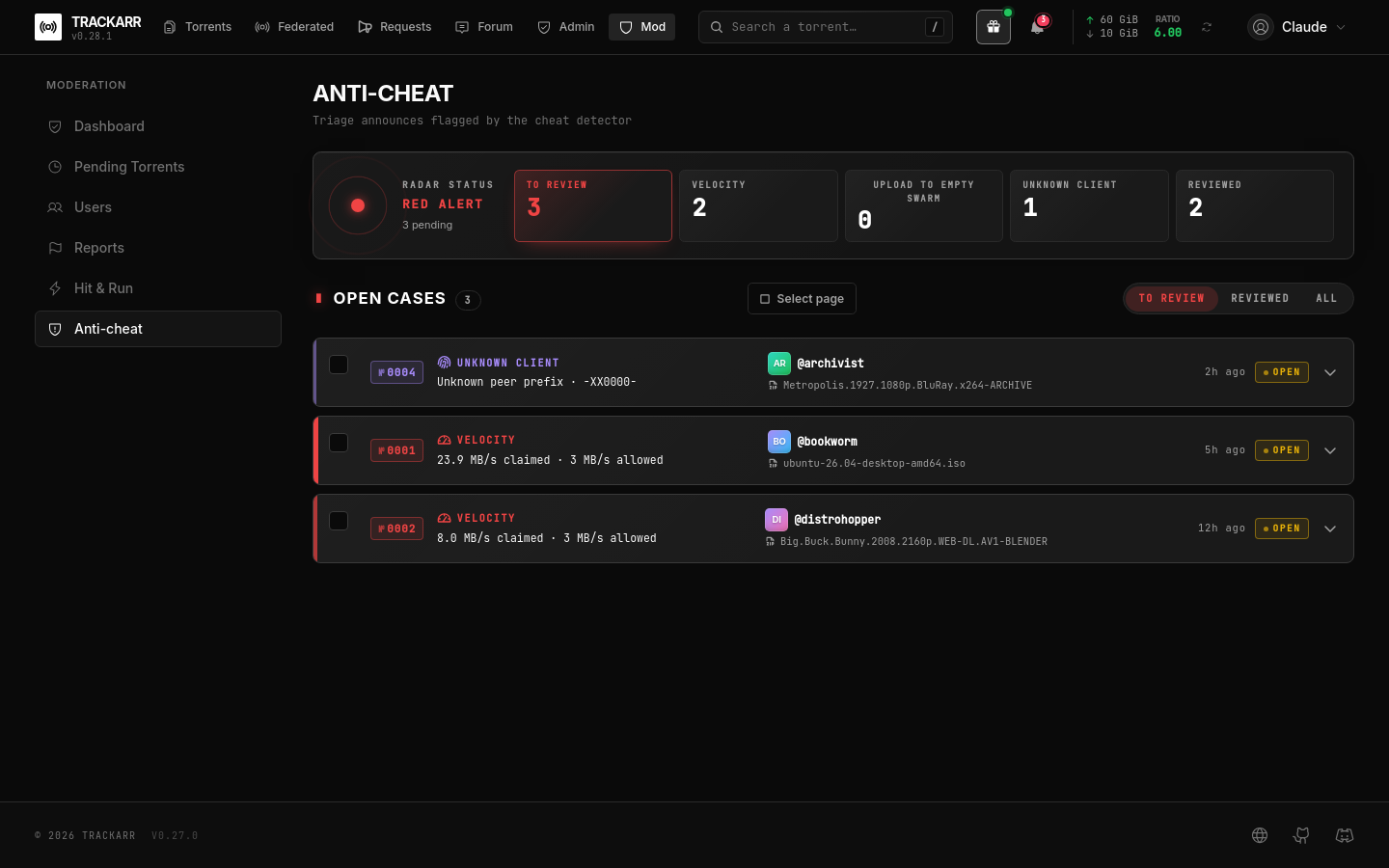
The tracker watches every announce for signatures of common ratio-cheating tools (RatioMaster, rustatio, …) and persists suspicious events to a moderation queue at /mod/anti-cheat. Nothing is ever auto-banned — the queue is a triage surface, not an enforcement engine. Moderators review each flag and decide whether to issue a warning, monitor, or ban manually.
What gets flagged
Three independent detectors run inside the Go tracker on every announce. Each one persists a row to anticheat_flags when it fires; many suspicious announces produce multiple rows.
Velocity
A peer claims an upload rate that's physically impossible. The detector compares the upload delta since the previous announce against an operator-set ceiling (default 80 MB/s, the realistic upper bound of a gigabit symmetric line):
delta_uploaded / elapsed_seconds > MaxUploadBytesPerSecondSeverity scales with how far over the cap the announce is:
low— 1×–2× the capmedium— 2×–5× the caphigh— >5× the cap
A velocity flag is the strongest single signal — manual cheaters rarely fake bandwidth in a way that doesn't trip this.
Empty-swarm upload
The peer reports an upload delta but the swarm has zero leechers at announce time. There's literally no one to upload to; the bytes can only be fabricated. Severity always high.
The detector subtracts the announcing peer's own state from the pre-update swarm counters so a self-announce isn't counted as "the leecher". The flag fires only when the real swarm-minus- self leecher count is zero AND the delta is positive.
Unknown client signature
The peer_id prefix doesn't match the BEP 20 whitelist of about 80 mainstream BitTorrent clients (qBittorrent, Transmission, Deluge, libtorrent-rasterbar, BitTorrent Mainline, …) AND the User-Agent header doesn't look like one of the real clients either. Only fires when there's actual upload delta — pure leechers with custom clients don't get tagged.
Severity is always medium. Some legitimate niche clients (developer builds, very old releases) trip this too, so the detector errs on the lighter side — a moderator reviewing the case can distinguish a curious user from a hand-rolled cheater via the peer_id / UA / behaviour combo.
The moderation queue
/mod/anti-cheat lays the flags out as a "radar console":
- Top strip: pulse indicator + KPI tiles (unreviewed total, per-kind counts, reviewed count). Tiles are clickable filters.
- Feed: each flag is a numbered case (
№ XXXX) with a severity ribbon (width scales with severity), a kind chip, an evidence summary (e.g.147 MB/s claimed · 80 MB/s allowed), a hash-gradient suspect avatar, the target torrent, and the time + verdict. - Inline detail: click a case to expand the evidence panel — peer_id, IP, User-Agent, raw JSON payload, and the review form.
Cases under 5 minutes old get a pulsing inner border in the kind tone, so a wave of fresh flags during a live incident is visible at a glance.
Reviewing a flag
When a moderator commits a verdict, the row is stamped with reviewedAt, reviewedById, reviewVerdict, and an optional reviewNote. Hitting the endpoint twice on the same flag rotates the reviewer and re-stamps the timestamp — useful for revisiting a decision.
The four primary verdict buttons cover the main outcomes:
| Verdict | When to use |
|---|---|
| Clean | False positive — legitimate client tripping the unknown-signature heuristic, or a velocity flag from a misconfigured detector. |
| Warned | First-offence pattern; staff messaged the user. |
| Banned | Decision to ban — issue the ban from the user admin page, then mark the flag here for the audit trail. |
| Monitoring | Inconclusive; keep watching the same user / torrent. |
The verdict text is free-form — buttons are presets but any short label (up to 40 chars) is accepted, so a team can adopt its own vocabulary.
A reviewNote (up to 500 chars) travels with the verdict so the next moderator landing on the same suspect's row sees why their predecessor closed it.
Data model
anticheat_flags
├── id               text PK
├── user_id          text → users(id)         ON DELETE CASCADE
├── torrent_id       text → torrents(id)      ON DELETE SET NULL
├── info_hash        text
├── kind             text  (velocity | no_leecher | unknown_client)
├── severity         text  (low | medium | high)
├── details          jsonb
├── peer_id          text
├── ip               text
├── user_agent       text
├── created_at       timestamp
├── reviewed_at      timestamp
├── reviewed_by_id   text → users(id)         ON DELETE SET NULL
├── review_verdict   text
└── review_note      text
Three supporting indexes: (user_id, created_at) for "all flags on this user", reviewed_at (the queue scan), and kind for the per-kind tiles.
Configuration
The detector lives entirely inside the Go tracker. Defaults match a typical private-tracker workload:
| Setting | Default | Override |
|---|---|---|
| Max upload bytes/sec (velocity cap) | 80 MB/s | ANTICHEAT_MAX_BYTES_PER_SECOND env (bytes/sec) |
| Detection runs in goroutine | yes | hard-coded (announce hot path stays fast) |
| Detection happens before the 1 TiB delta clamp | yes | hard-coded (detector sees raw client claims) |
Increasing the velocity cap is the safest tuning knob if you serve a community with symmetric 10 Gb/s connections. Lowering it is risky — the false-positive rate climbs fast below ~50 MB/s.
Privacy
- The IP and User-Agent stored on the flag are visible only to staff (
/mod/anti-cheatrequires a moderator session). - The user's username + monogram avatar links through to the public profile; no PII beyond what's already public on the profile page is exposed.
- Anonymous announces (no passkey) cannot reach the detector — the tracker rejects them upstream.
Limitations
- The detector is statistical, not cryptographic. A sophisticated cheater can spoof the peer_id, User-Agent, and pace their fake announces under the velocity cap to evade all three heuristics. The queue catches the lazy 90 %, not the careful 10 %.
- An empty swarm at announce time may be a transient state (the seeder lost their last peer two seconds ago) rather than a fake announce. Manual triage handles the edge cases.
- Velocity uses the previous announce's elapsed time. The first-ever announce from a user can't be tagged this way because there's no baseline yet.