
Hit-and-Run (HnR)
A hit-and-run is a user who downloads a torrent and stops seeding before the operator-defined seed-time threshold. Trackarr enforces HnR at the per-(user, torrent) level so the consequences land on the responsible account, not the operator's mood.
Concepts
| Term | Meaning |
|---|---|
| Required seed time | How long a user must seed a given torrent before HnR is cleared. Default 24 h. Set in hours from /admin/settings → Hit & Run (stored in seconds as hnr_required_seed_time). The torrent page announces it before the download ("commits you to N h of seeding"). |
| Grace period | Window after downloadedAt during which a not-yet-completed download is not flagged. Default 72 h, set in hours from /admin/settings → Hit & Run (hnr_grace_period). Tracking itself is switched on there too (hnr_enabled, off by default). |
| Completed | A row reached seedTime >= requiredSeedTime. completedAt is set; isHnr is forced to false and never re-flips. |
| Exempt | Moderator manually waives the requirement. Engine ignores the row from that point onward. |
Flagged (isHnr = true) | The grace period expired, the user still hadn't met the requirement. Auto-clearable by completing or by moderator action. |
Data model — hnr_tracking
One row per (user, torrent). The unique index hnr_user_torrent_idx guarantees idempotency.
| Column | Notes |
|---|---|
userId | FK → users (cascade delete). |
torrentId | FK → torrents (cascade delete). |
downloadedAt | When the user first either clicked Download or completed the torrent. |
seedTime | Accumulated seconds seeded (incremented by the tracker on every announce). |
requiredSeedTime | Snapshot of the threshold at insert time. Lets the operator change the global default without retroactively re-graded existing rows. |
isHnr | true once the grace window expired without completion. |
isExempt | Manual moderator waiver. |
completedAt | Set when seedTime >= requiredSeedTime. Final state for that row. |
uploaded, downloaded | Per-(user, torrent) byte counters maintained by the tracker. Drives the /downloads history page. |
Lifecycle
                     POST /api/torrents/:hash/download
                                  │
                                  ▼
                          recordDownloadClick()
                          (ON CONFLICT DO NOTHING)
                                  │
                                  ▼
                       ┌─────────────────────────┐
                       │ row inserted            │
                       │  isHnr     = false      │
                       │  completedAt = null     │
                       └────────────┬────────────┘
                                    │
                ┌───────────────────┼───────────────────┐
                │                   │                   │
                ▼                   ▼                   ▼
   tracker announce         grace expired,       moderator action
   updates seedTime         not yet completed     `exempt` / `clear`
                │                   │                   │
                ▼                   ▼                   ▼
        seedTime ≥ required?   checkAndMarkHnrs    isExempt = true
                │              flips isHnr=true    OR isHnr=false
                ▼              + notify             + completedAt=now
        completedAt = now
        isHnr = false (final)
Where the seed-time delta comes from
The Go tracker's announce handler diffs uploaded / downloaded against the previous peer entry on every announce and persists them into hnr_tracking in the same transaction it updates users.uploaded / users.downloaded. A separate ticker calls updateSeedTime(user, torrent, secondsSeeded) to bump seedTime. Exempt or completed rows short-circuit early so no further state churn happens on them.
The previous-announce snapshot lives in Redis with a 24 h TTL by default, configurable via TRACKER_PEER_TTL (Go duration string — 24h, 90m, 7200s; values below 15m are clamped to that floor). Two cases used to silently zero the delta:
- First announce ever for a given (peer_id, info_hash) pair — Redis has no
prev, so a naive diff produced0. - Gap longer than the TTL — same effect, the peer hash expired between announces.
To recover those bytes, when the very first announce for a peer carries event=started, the tracker trusts the client's declared cumulative uploaded / downloaded as the initial delta. That covers honest clients that resume a session or rejoin after sleep without losing what they already pushed. The existing 1 TiB/announce cap bounds the worst-case spoofing window, and a started announce is still rate-limited like any other.
When rows get flagged
checkAndMarkHnrs() runs from the API plugin loop. On each pass:
- It reads the current grace period from
/admin/settings(getHnrGracePeriod). - It selects every row where
isHnr = false,isExempt = false,completedAt IS NULL, anddownloadedAt < now - graceWindow. - It flips those rows to
isHnr = truein a singleUPDATE … RETURNING. - For each flipped row it fans out a
hnr_violation_markednotification to the user (resolving the torrent name so the inbox row is meaningful).
This means the user is always notified the moment they cross the line — they don't have to discover the flag by checking their profile.
What gets flagged user-visibly
| Surface | Notes |
|---|---|
/downloads | Personal history of every torrent the user clicked Download on. HnR rows are colour-rail flagged with a countdown ("⏳ 4h 12m remaining" before grace expiry) or the active flag once expired. |
/me | Hero KPI strip carries the user's current HnR count. |
/users/[id] | Public profile shows the same KPI to other members. |
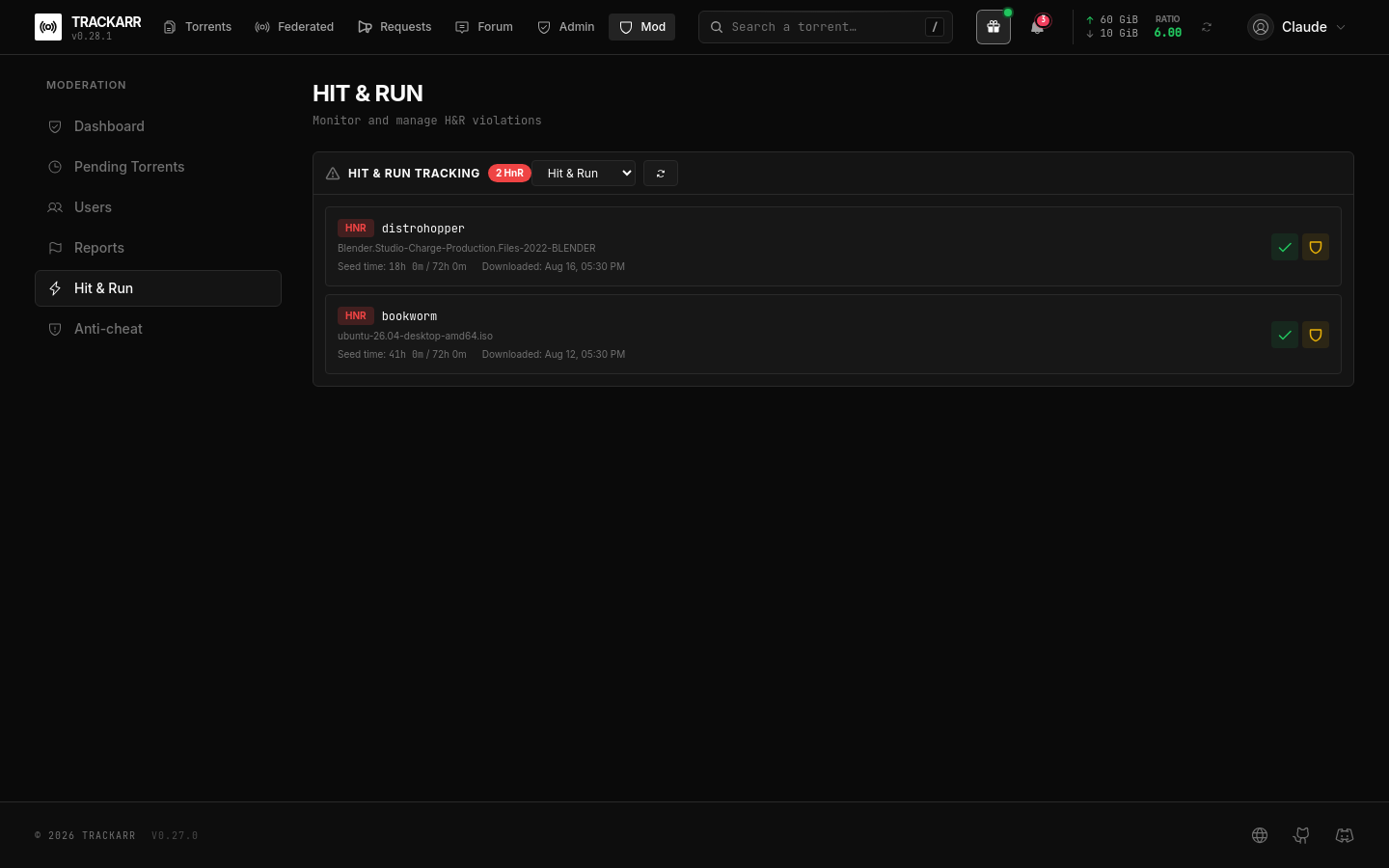
/mod/hnr | Moderator queue (filterable by status: open / completed / exempt). |
| Notification | hnr_violation_marked → goes through the user's notification routing. |
Moderator actions
The queue at /mod/hnr exposes two actions per row:
| Action | Effect |
|---|---|
| Exempt | Sets isExempt = true. Future seed-time updates skip the row; the flag never re-fires. |
| Clear | Sets isHnr = false and completedAt = now, the same final state a legitimate completion reaches. Use this for one-off forgiveness. |
Both end up in hnr_user_is_hnr_idx-indexed queries the same way — the audit columns (completedAt, isExempt) tell the two paths apart.
Auto-role interactions
roleRules.ts exposes hnrCount (current isHnr = true rows) and completedSeeds (rows with completedAt IS NOT NULL) as auto-assignment fields. Common patterns:
- "Member" → "Power User" when
completedSeeds ≥ 50ANDhnrCount = 0. - "Member" → "Probation" when
hnrCount ≥ 3.
When a moderator exempts or clears a flag, the affected user's roles are not auto-recomputed by the action itself — admins can trigger a sweep from /admin/roles (POST /api/admin/roles/recompute).
See Roles & Permissions.
Disabling HnR
Set the feature flag to off in /admin/settings:
- New downloads stop inserting
hnr_trackingrows viacreateHnrEntry(). - Existing rows are kept, but
checkAndMarkHnrs()becomes a no-op (returns 0 immediately). - The
recordDownloadClick()path still records a row, because the Downloads page is a personal log — it shouldn't vanish when the operator switches enforcement off.
Bonus interactions
The seed-bonus accumulator reads seedTime from the same table to credit seeding_milestone grants (24 h / 1 week / 30 d thresholds). HnR enforcement and bonus crediting share their seedTime source-of-truth — there's no risk of "rewarded for seeding but still flagged" inconsistencies.
See Seed Bonus.
API surface
| Method | Path | Auth | Notes |
|---|---|---|---|
| GET | /api/users/hnr | user | Current user's flagged rows (used by the bell badge fallback). |
| GET | /api/admin/hnr | mod | Queue. Filters: `status=open |
| PUT | /api/admin/hnr/:id | mod | Body: `{ action: 'exempt' |
| GET | /api/me/downloads | user | Per-torrent history with HnR state inline. |
Implementation reference
| Concern | File |
|---|---|
| Schema | packages/db/src/schema.ts (hnr_tracking) |
| HnR logic (insert / update / mark) | apps/api/utils/hnr.ts |
| Tracker-side delta updates | apps/tracker/internal/server/handler.go (announce path) |
| Mark-as-HnR sweeper | called from the API plugin loop (checkAndMarkHnrs) |
| Moderator queue | apps/api/routes/api/admin/hnr/*, apps/web/app/pages/mod/hnr.vue |
| User downloads page | apps/web/app/pages/downloads.vue |