
Seed bonus economy
Trackarr ships a seed-bonus economy: users earn points for seeding, spend them in a shop on upload-credit and invites, and admins can grant or revoke points by hand. Distinct from bonus events (which scale users.uploaded deltas globally during a window), the bonus economy is per-user, persistent, and operator-tunable end-to-end.
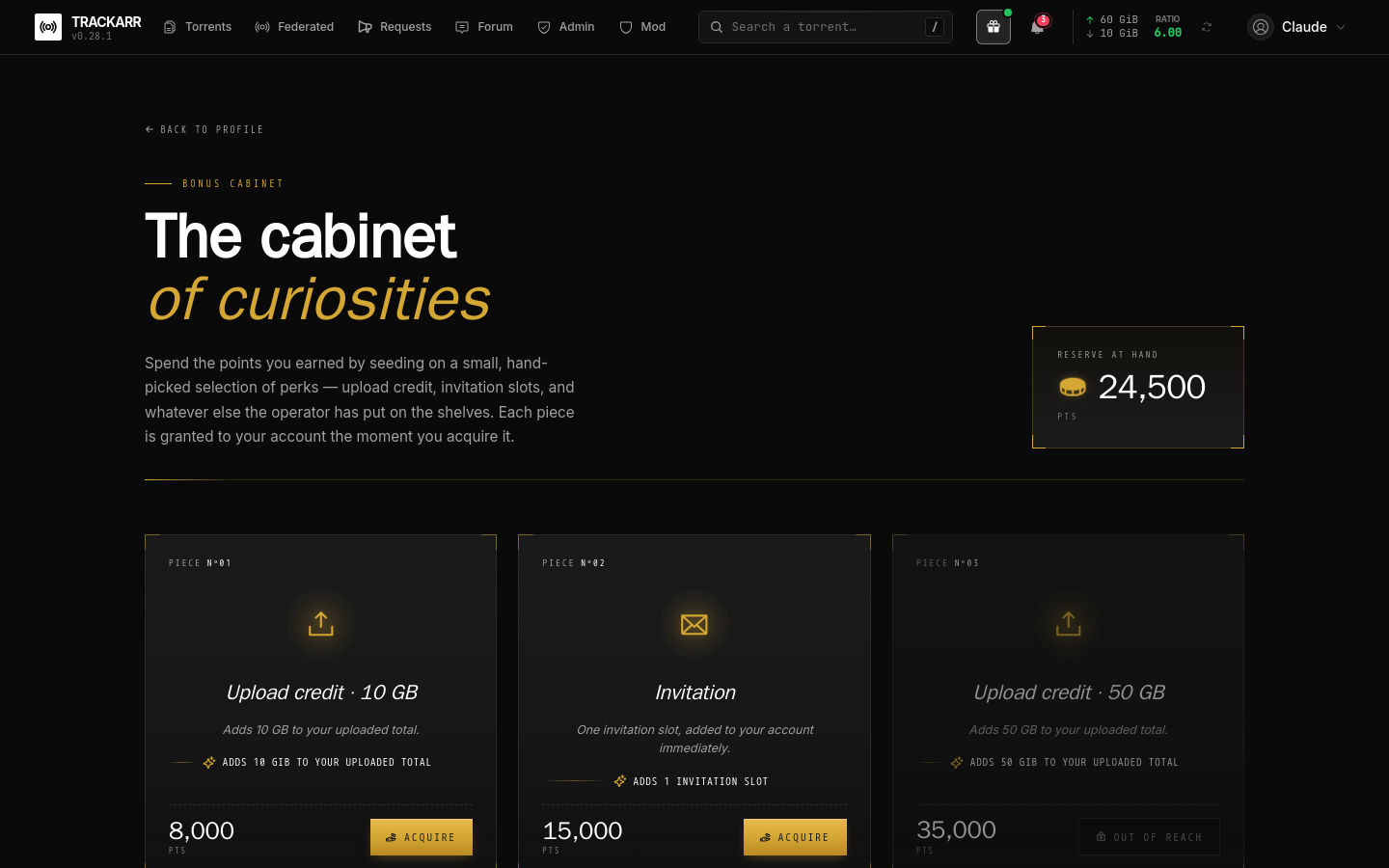
What users see
/me — Bonus reserve
The profile page surfaces a compact wallet readout in the hero KPI strip (Uploaded · Ratio · Downloaded · Released), plus a dedicated bonus row that shows the running balance with an animated counter. The display is deliberately understated — large enough to read, small enough not to shove an admin metric into the user's face every page load.
The Uploaded KPI splits into "real seeded" + "(incl. X bonus)" so the user can see at a glance how much of their lifetime upload came from shop purchases vs. real seeding. Same data shape as the admin user registry uses.
/shop — Bonus shop
Operator-curated catalogue of items. Each item has:
| Field | Notes |
|---|---|
name | Display name, free text |
description | Optional one-liner shown under the name |
cost | Points required to purchase |
stock | null for unlimited; otherwise a hard cap |
effect | One of upload_credit / invite |
effect.args | Effect-specific payload (bytes / count) |
The two built-in effects:
upload_credit— addsargs.bytesto bothusers.uploadedandusers.bonusUploadedin one transaction. The user's ratio improves; thebonusUploadedsubset lets the UI label that the gain came from the shop, not from real seeding.invite— addsargs.counttousers.invitesRemaining. Useful when registration is invite-only and the operator wants seeded users to bring in more.
Buying is gated on cost <= bonusPoints and on stock; the buy endpoint runs everything inside a single transaction so a concurrent purchase can't drop the balance into negative territory or sell the last copy twice.
How points are earned
The earning rules are fully customisable from /admin/seed-bonus-rules. Each active rule contributes to a per-minute rate:
points/minute  ←  Σ active rules
                       per-user-context (ratio, age, seed count, torrent age, …)
Out of the box, three rule presets cover the classics:
| Rule | Curve |
|---|---|
| Time seeding | Flat rate per minute of active seeding (e.g. 0.1 pts/min/seed) |
| Per-torrent age | Older torrents pay more (rewards keeping the long tail alive) |
| Per-torrent rarity | Few seeds → higher per-minute rate (rewards filling rare swarms) |
Tiered curves are a first-class concept: every rule carries an array of {threshold, multiplier} tiers so the operator can write something like "first 5 active seeds × 1.0, next 5 × 1.5, beyond × 2.0" without writing custom code. The curves render as live previews in the admin UI so an operator can see the shape before saving.
Granting happens on the announce hot path — every event != stopped seeder pings update the per-user accumulator, which a periodic batch flushes to users.bonusPoints. The accumulator is in Redis so a tracker restart doesn't drop in-flight points.
Admin levers
/admin/seed-bonus-rules — Edit, enable/disable, and re-order earning rules. Each row carries:
- A live curve preview.
- The expected pts/minute for a "median" user (computed from current swarm stats).
- A toggle to disable the rule without deleting it.
/admin/shop — CRUD on shop items. Adding a new effect type is a purely SQL-driven affair: insert the item with effect.type = 'foo', extend the buy endpoint's effect dispatcher, and it shows up in the storefront immediately.
/admin/users — The bonus column shows the current balance and the icon turns accent when the user has any positive points. Clicking opens the Adjust bonus modal: add or remove an integer amount with a free-text reason that's persisted in the audit log. Useful for:
- Compensating users after a tracker outage.
- Refunding shop purchases that triggered an
upload_creditapply failure (rare; the buy path is transactional but the on-disk apply has retried writes). - Removing points after detecting cheating.
Adjust bonus is admin-only — moderators can see the registry on
/mod/usersbut the bonus column hides its action button there to keep the surface focused on moderation.
Real upload vs. bonus upload
Two separate columns track upload:
| Column | Driven by |
|---|---|
users.uploaded | Every announce delta + any upload_credit shop purchase |
users.bonusUploaded | Only the upload_credit shop purchase delta |
The starter upload credit a new user gets at registration also lands in bonusUploaded so the /me Uploaded KPI shows X — (incl. Y bonus) from day zero. There's a one-shot backfill heuristic for users who registered before this split landed: if users.uploaded == settings.starter_upload, we infer the entire balance came from the starter and stamp bonusUploaded to match.
The split is informational — ratio and HnR enforcement still operate on users.uploaded alone. There's no concept of "real ratio"; the distinction exists for the user's own situational awareness.
The shop
Users spend bonus_points from /shop. The catalogue lives in shop_items and is curated from /admin/shop; every purchase writes a row in shop_purchases so the operator has a full audit ledger.
Item types
The type column is a closed enum — adding a type is a three-step contract in apps/api/utils/shop.ts (extend the union, add a Zod payload schema, add the handler). Today two are shipped:
| Type | Payload | Effect |
|---|---|---|
upload_credit | { bytes: integer ≤ 10 TiB } | Adds bytes to both users.uploaded and users.bonusUploaded. Pure ratio relief. |
invite | { count: integer ≤ 10 } | Bumps users.invites_remaining by count slots. |
The per-purchase caps (10 TiB, 10 invites) are hard-coded — they exist so a typo in /admin/shop can't gift petabyte-scale ratio or hundreds of invite slots. If you need a bigger bundle, create a second item.
Catalogue fields
| Field | Notes |
|---|---|
name | Shown on the shop card. |
description | Markdown body, rendered below the title. |
icon | Phosphor icon id (e.g. ph:gift-bold). Optional. |
cost | Whole points (same unit as users.bonus_points). |
stock | null = unlimited. When set, decrements per purchase and the item disappears from /shop at 0. |
enabled | Lets an admin pause an item without losing its config. |
Purchase flow
              /shop                              POST /api/shop/buy
   ┌─────────────────────────┐                  ┌──────────────────┐
   │ user browses items      │ ───── buy ─────► │ purchaseItem()   │
   │ /api/shop/items         │                  │ (utils/shop.ts)  │
   └─────────────────────────┘                  └────────┬─────────┘
                                                         │
                                                         ▼
                                              ┌────────────────────┐
                                              │ DB transaction:    │
                                              │  - FOR UPDATE row  │
                                              │    lock on item    │
                                              │  - FOR UPDATE row  │
                                              │    lock on user    │
                                              │  - check balance   │
                                              │  - check stock     │
                                              │  - decrement both  │
                                              │  - apply effect    │
                                              │  - insert row in   │
                                              │    shop_purchases  │
                                              └────────────────────┘
The FOR UPDATE locks make race conditions on stock or balance impossible. POST /api/shop/buy is rate-limited as a mutation, so a hijacked session can't churn the ledger faster than the bucket allows.
Errors
| HTTP | Cause |
|---|---|
| 400 | Malformed payload (typically a stale admin-form submission). |
| 403 | Item exists but enabled = false (paused by admin). |
| 404 | Item id doesn't exist. |
| 409 | Stock hit zero between the listing and the buy click. |
| 402 | Not enough bonus_points. |
Every error returns the post-balance + a structured reason so the FE can render a precise toast.
Audit ledger (shop_purchases)
Each purchase row preserves a snapshot of the item at buy time — cost, name, payload — so renaming or reconfiguring an item later doesn't rewrite history. Useful for refund flows or compliance questions: an admin can always answer "what did this user actually spend their points on?" from the ledger alone.
Implementation reference
| Concern | File |
|---|---|
| Shop catalogue + buy endpoint | apps/api/routes/api/shop/items.get.ts, apps/api/routes/api/shop/buy.post.ts |
| Earning rules CRUD | apps/api/routes/api/admin/seed-bonus-rules* |
| Admin shop CRUD | apps/api/routes/api/admin/shop* |
| Admin user bonus adjustment | apps/api/routes/api/admin/users/[id]/bonus.post.ts |
| Tracker-side accumulator (announce hot path) | apps/tracker/internal/server/handler.go (seed-time recorder) |
| Bonus point flush (Redis → Postgres) | apps/api/redis/seed-bonus-flush.ts (periodic) |
| User-facing UI | apps/web/app/pages/me.vue, apps/web/app/pages/shop.vue |
For the announce-time multipliers (Freeleech / Silverleech / custom), see Bonus events. The two systems are independent — a user can earn rate-limited points while a global Freeleech window also doubles their uploaded deltas — and the announce code applies both in the same atomic block so an event boundary can never desync from a bonus accumulator tick.