
Federation
Connect independent Trackarr instances so they can share catalogue, social activity, account proofs and (optionally) swarms — a private, owner-curated network rather than one monolithic tracker. Every instance stays sovereign: it keeps its own users, ratio economy, moderation and data, and decides — per partner, per direction — exactly what it shares.
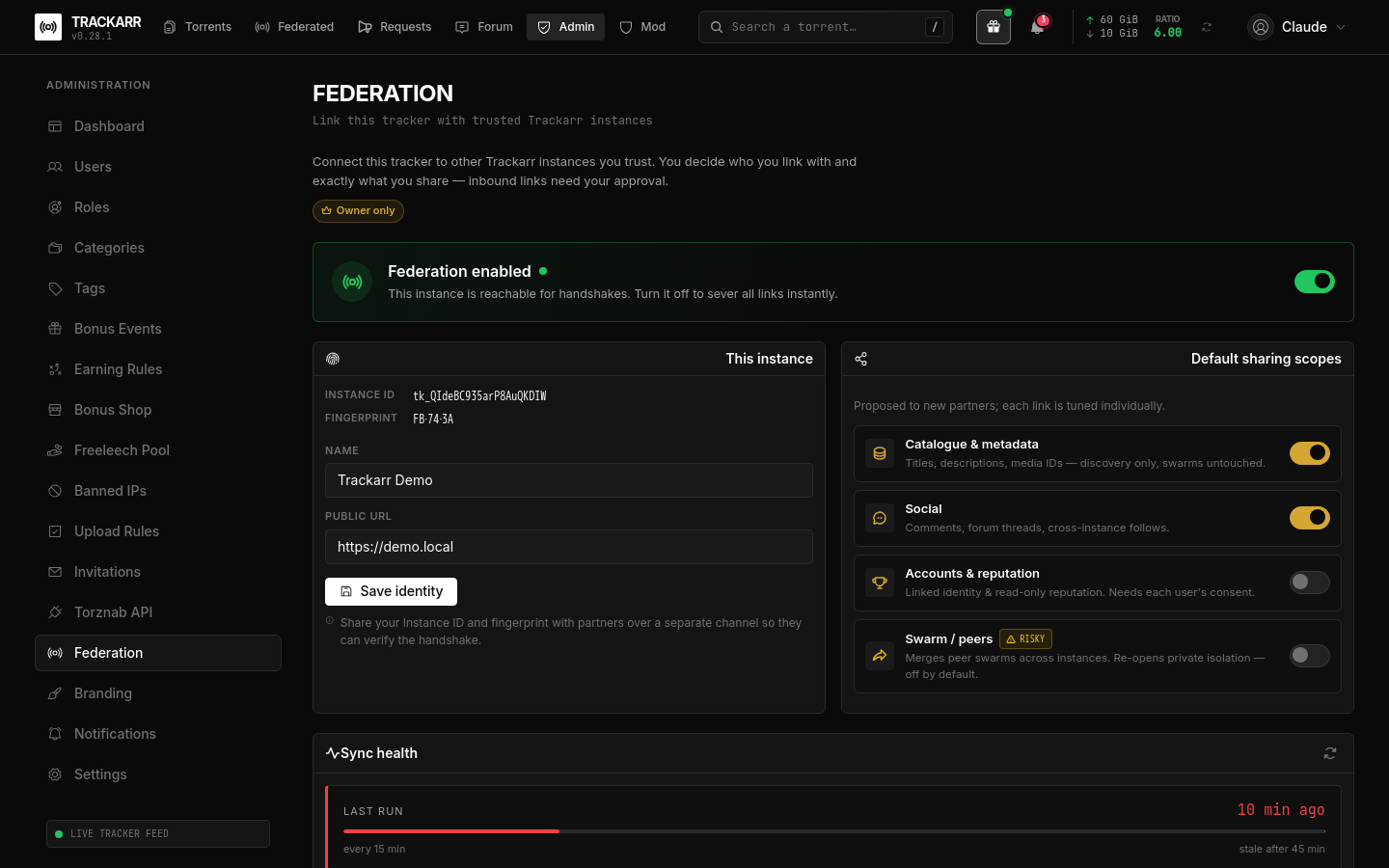
Federation is off by default and only the owner (an admin) can turn it on, from /admin/federation.
Trust model
There is no central authority and no PKI. Trust is established once, by hand, between two owners.
- Each instance owns a single Ed25519 keypair, generated lazily the first time federation is enabled. The private key is encrypted at rest (same cipher as notification-channel secrets —
CHANNEL_ENCRYPTION_KEY, falling back toNUXT_SESSION_SECRET). - An instance's
instanceIdis the fingerprint of its public key (tk_+ truncated SHA-256 over the SPKI). It can never drift from the key it names. - Every server-to-server (S2S) request is signed (see Security).
- A peer only exists once it's in your allow-list (
federation_peers), added through a double opt-in handshake that both owners confirm.
The handshake (double opt-in)
Owner A                                  Owner B
  │  add B's URL in /admin/federation
  │  POST /api/federation/handshake  ───────────►  pending_in row + owner notice
  │            (status: pending_out)               (B verifies A's fingerprint)
  │                                                 owner B approves → scopes chosen
  │  ◄───────  POST /api/federation/callback ─────  (status: active on B)
│ status: active callback signed with B's key- A initiates. Owner A enters B's public URL. A sends a signed
handshakecarrying A's public key + offered scopes; A's side is nowpending_out. - B reviews. B stores a
pending_inrow and notifies its owner. Owner B verifies the short fingerprint (e.g.8E·44·A2) with owner A out of band (the only defense against an impostor URL) and approves, choosing what B shares and accepts. - B calls back. B flips to
activeand sends a signedcallback; A flips toactivetoo. The link is live.
Re-handshakes from a known peer never silently re-open a blocked/revoked link, and a callback only ever completes an outbound handshake — it can't rewrite an established link's scopes.
Scopes
Sharing is granular and asymmetric. For each peer you set two independent scope sets:
| Field | Meaning |
|---|---|
sharesWithThem | what you expose to that peer |
acceptsFromThem | what you consume from that peer |
Each set is four booleans:
| Scope | Unlocks |
|---|---|
catalog | torrent metadata discovery (browse + search) |
social | federated comments & forum, follow notifications |
accounts | identity-link verification + read-only reputation |
swarm | peer cross-announce (highest risk — see Swarm) |
You can cut one scope without touching the others (e.g. drop social, keep catalog) at any time from the peer's Manage dialog — it takes effect on the next request.
The four axes
Axis 1 — Catalogue
Discover and search partner content without touching swarms.
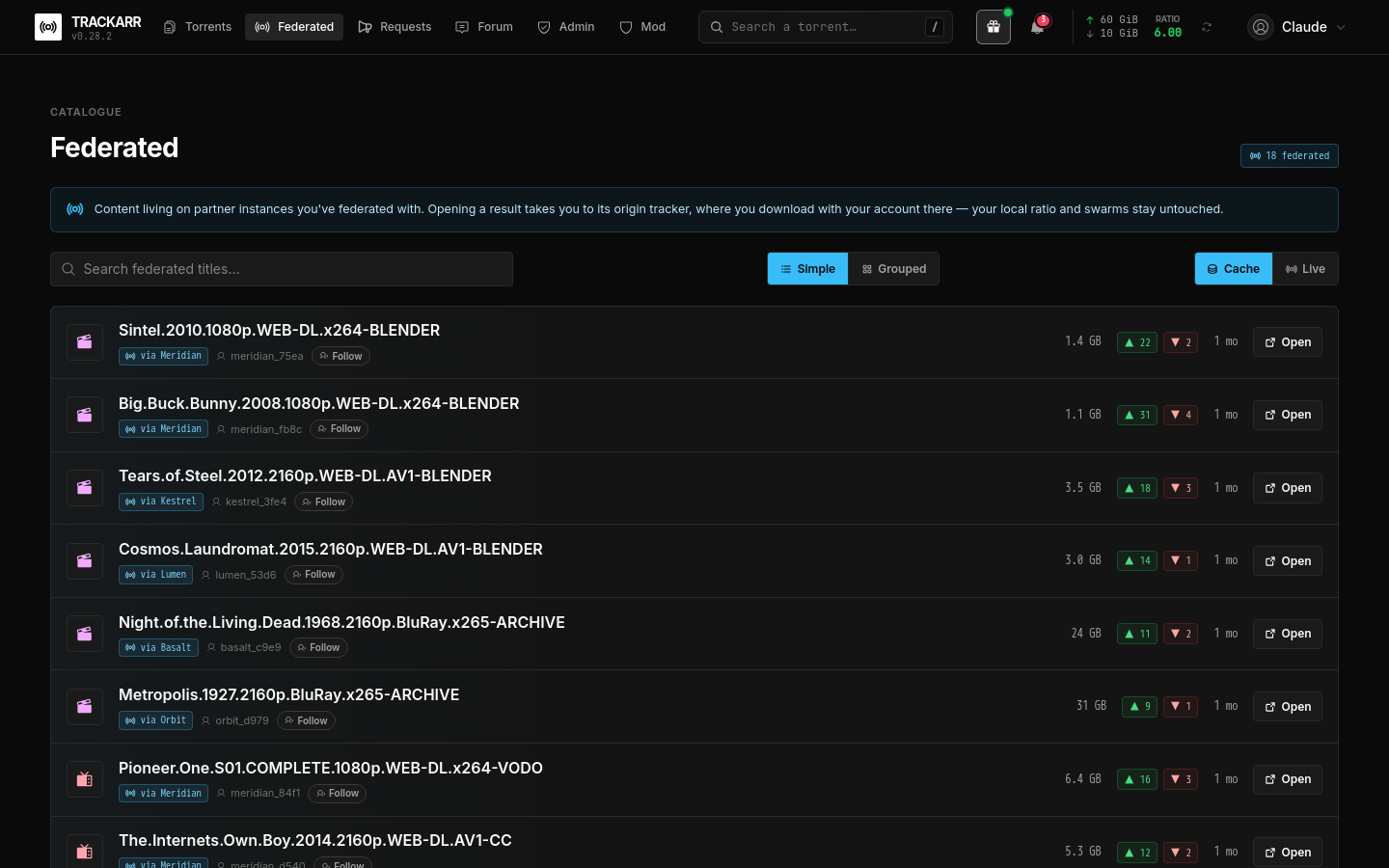
- Cache mode (default). A background cron (
FEDERATION_SYNC_INTERVAL, 15 min) reconciles with eachcatalog-sharing peer and pulls whatever is missing into a local, read-only mirror (remote_torrents). Browse it at/federated. - Reconciliation, not a cursor. The two sides compare fingerprints of ranges of their catalogues and converge on exactly what differs, in a handful of round trips whatever the size. When nothing has changed that is one request and one "we agree" — and unlike a watermark it is proven rather than assumed, so a release that went missing for any reason is found and repaired on the next pass instead of never.
- The partner drives our work, so the work is budgeted. A range that is open at an end costs an aggregate over most of the record set — measured at 115–145 ms, and 300–465 ms more when the two sides disagree, over 200 000 records. Four such ranges per message and 120 per minute per peer, which is five times what a real sync needs (two per message, twelve rounds a tick). Over budget, the expensive ranges come back as
pendingand the initiator re-sends them: a throttled round is deferred, never failed, so nothing is lost and no healthy peer ever shows an error for it. - Live mode. Toggle Live on
/federatedto fan out a signedGET /api/federation/search?q=to every partner in real time (time-bounded, best-effort). It answers with the same signed records the feed streams, so a live result is verified and cached exactly like a synced one. - Signed records. Everything a partner asserts about a release travels as an immutable record it signed with its own key, verified on arrival. A partner can decline to answer or serve you nothing — it cannot forge a release it did not publish, nor alter one in flight. New uploads, edits and withdrawals all arrive in that one stream: an edit is a record that supersedes another, a withdrawal is a tombstone.
- Swarm counts are the exception. They change constantly, so they cannot live inside an immutable record and travel unsigned on their own feed. Treat a partner's seeder count as a hint, not a promise.
- Dedupe. A remote item already present locally is flagged "also here" (same info-hash) or "same content here" (same content-signature, different info-hash). Hints only — the mirror is never merged into your local
torrentstable. - Download. A federated torrent's link points back to the origin instance — you download there, with your account there. Trackarr never serves a partner's
.torrentwith your local passkey.
What crosses the wire is metadata only: name, size, category, tags, media IDs, stats, and the uploader's display name — never the .torrent bytes nor a real user id.
Axis 2 — Social
A light fediverse layer, pull-based and read-only.
- Follows. Follow a remote uploader from
/federated; when the catalogue sync first sees a new upload by someone you follow, you get afederated_followed_uploadnotice (capped per run; the initial backlog is never blasted out). - Comments & forum. A remote torrent's comments and a partner's recent forum topics are fetched live, rendered read-only with attribution, and sanitized exactly like local content (DOMPurify). Aggregated forum view at
/forum/federated. - Sovereignty. Everything remote is gated on the peer's
socialscope; cut it and the exchange stops immediately. No remote moderation is ever imposed on you.
Axis 3 — Accounts & reputation
Portable identity, never portable economy.
- Linked identity (recommended). A local user proves they own an account on a partner: Trackarr issues a one-time
trackarr-verify-<hex>code, the user pastes it into their bio on the partner, and a signedGET /api/federation/verify-identityconfirms it server-side. A "verified on partner.example" badge appears. Manage at/federated-identity. - Reputation (read-only). For a verified link, ratio / uploads / member-since can be pulled as a display signal, always labeled with its source. It is never folded into your local ratio, bonus or invites.
- No SSO. Single sign-on is intentionally out of scope — the zero-knowledge auth model makes it unsafe, and account economies stay isolated.
Axis 4 — Swarm
Highest risk — off by default
A private tracker deliberately isolates swarms. Cross-announce pierces that isolation, so it is gated three ways and ships disabled.
Mutualise seeders/leechers between instances, but only when all of:
- the tracker has
TRACKER_FEDERATION_SWARM=true(off by default), and - the peer link has the
swarmscope (both directions), and - the individual torrent is opted in (
federate_swarm, toggled by the uploader or staff on the torrent page).
When enabled, the API pulls partner peers (signed) into a short-lived Redis cache (remote_peers:{infoHash}) and the Go tracker mixes them into the announce response. Exposure is minimal and hardened:
- only
ip/port/isSeederleave — neverpeer_id,ipHashor a user; - private / loopback / link-local IPs are filtered out both when exposing and when ingesting;
- a 60-min freshness window and a per-torrent cap apply.
Ratio integrity is preserved: each instance only ever counts its own announcing users. Remote peers are injected read-only into the peer list — they never enter ratio, Hit-and-Run or stats accounting.
Governance
From /admin/federation, per peer, the owner can:
- Approve an inbound request (choosing scopes).
- Suspend / Reactivate — pause exchange without deleting the link.
- Block — refuse a peer.
- Edit scopes — change what you share/accept after the fact.
- Remove — delete the link entirely.
Status transitions are enforced by a central validator (a revoked link is terminal; a pending handshake must be approved or deleted, not patched). Any non-active status immediately makes every inbound S2S endpoint reject the peer.
Standards, and where this diverges
Federation reuses established formats where they fit, and says so where it does not:
- Records are FEP-d8c8
Torrentobjects — the sametype,@contextandbt:infohash_v1a generic fediverse consumer understands — extended with atrackarr:vocabulary served at/api/federation/context. - Proofs are W3C Data Integrity with the
eddsa-jcs-2022cryptosuite (a Recommendation as of May 2025): the signing input isSHA-256(proofConfig) ‖ SHA-256(document), each canonicalised with RFC 8785 (JCS). Content addresses aresha256:<hex>over the canonical bytes, excludingproofandid. - Identity keys are
did:key(Ed25519, multicodec0xed01).did:keyhas no rotation by construction — the identifier is the key — so succession and revocation are layered on top rather than assumed from the method.
Divergence from FEP-c390 (Identity Proofs), deliberate. A portable-identity assertion here is a signed Person record carrying alsoKnownAs + the evidence that proved each alias, reconciled and relayed like any other record. FEP-c390 instead attaches a VerifiableIdentityStatement to an actor's attachment, with alsoKnownAs naming the actor's own id. The two express the same fact — "these identifiers are one person" — but this design makes the assertion a first-class, relayable record (so it survives the origin instance disappearing, which is the case that matters) rather than an attachment resolved by fetching a live actor. Converging on the FEP-c390 shape for cross-fediverse interoperability is possible later; it is not done today, and this note is the honest statement of that.
Security
| Concern | Measure |
|---|---|
| Authenticity | Ed25519 HTTP message signatures on every S2S call: x-trackarr-instance/date/digest/signature. |
| Tampering | The signature covers METHOD \n PATH \n DATE \n DIGEST; digest binds the exact body bytes. |
| Replay | ±5-min clock window plus a per-signature nonce cache (Redis SET NX). |
| Identity | instanceId is the public-key fingerprint; the handshake rejects an id that doesn't match. |
| Authorization | Every inbound endpoint checks allow-list + status==='active' + the required scope, in one shared guard. |
| Abuse | IP rate-limit and a per-instanceId rate-limit (can't be bypassed by rotating egress IPs). |
| SSRF | All outbound calls go through safeFetch (blocks loopback / private / link-local / metadata ranges, re-validates every redirect hop). |
| XSS | Remote text is DOMPurify-sanitized; partner-supplied URLs are http(s)-only before any :href. |
| Economy | Remote catalogue is a read-only mirror; reputation is display-only; swarm peers never touch ratio. |
| Secrets | The instance private key is AES-GCM encrypted at rest. |
Configuration
Federation introduces no required variables — it provisions its key on first enable.
| Variable | Read by | Default | Purpose |
|---|---|---|---|
FEDERATION_SYNC_INTERVAL | api | 900000 (15 min) | Catalogue-sync cron period (ms). No-op while federation is disabled. The health page's "behind" threshold is 3 × this, floored at 15 min — lowering it to sync faster will not paint healthy peers amber. |
FEDERATION_REQUIRE_AUDIENCE | api | false | Reject inbound S2S signatures — and relay countersignatures — that carry no audience binding. Turn on only once every partner runs a build that sends it. |
TRACKER_FEDERATION_SWARM | tracker | false | Master switch for swarm cross-announce on the Go tracker. |
CHANNEL_ENCRYPTION_KEY | api | — | Encrypts the instance private key at rest (falls back to NUXT_SESSION_SECRET). |
Clocks must be in sync
Every S2S request carries a signed timestamp and is rejected outside a ±5-minute window. A partner whose clock drifts past that becomes unreachable in both directions, surfaced only as http 401 in its last error. Run NTP on every instance in a mesh.
Relay and public catalogue are one-way doors, and relay costs disk
Turning relay on retroactively pulls every partner's whole catalogue (their bytes, not just yours) and re-advertises it to your other partners — plan for the disk. Neither relay nor the public catalogue can un-publish what has already left: a partner that took a record in holds a signed copy, and a withdrawal is a request it may ignore.
Local two-instance testing
safeFetch blocks loopback and private ranges by design, so two instances on the same host/LAN can't federate over localhost/RFC-1918 addresses. Use public hostnames or set SAFE_FETCH_ALLOW_HOSTS to the peer hostnames.
Data model
All federation state lives in dedicated tables — the local economy schema is untouched.
federation_config        singleton: master switch, this instance's identity, default scopes
federation_peers         the allow-list: base_url, instance_id, public_key, status,
                         shares_with_them / accepts_from_them (jsonb scopes)
federation_sync_state    per-peer × resource sync cursor (catalogue watermark)
remote_torrents          read-only mirror of partner catalogues (never merged into `torrents`)
federated_follows        local user → remote username subscriptions
federated_identities     local user ↔ remote account links (pending / verified)
torrents.federate_swarm  per-torrent swarm opt-in flag
Swarm cross-announce uses no table — it's a Redis cache (remote_peers:{infoHash}) read by the Go tracker behind its flag.
Sharing data, not just metadata
Federation mirrors a partner's catalogue; on its own that only lets you see what exists elsewhere. Turning "I see it" into "I can act on it" — content addressing (BEP 52), Request here, cross-seed matching, mesh availability, and the credit settlement a future content relay needs — is its own guide: federation-data-sharing.md.
Pages at a glance
| Page | What |
|---|---|
/admin/federation | Owner console: master switch, identity, peers, governance. |
/federated | Browse/search the federated catalogue (Cache / Live). |
/federated/:id | A remote torrent's detail + live comments. |
/forum/federated | Aggregated partner forum topics. |
/federated-identity | Manage your linked remote identities + imported reputation. |